

TL;DR:
- A trustworthy prize programme has clear official rules, no payment requirements, and transparent winner notification. Verifying a sponsor's identity, contact details, and winner history helps distinguish legitimate contests from scams. Always treat unverified notifications and offers requesting money with suspicion to protect personal information.
A trustworthy prize programme is defined by three non-negotiable features: clear official rules, no payment requirements, and transparent winner notification. Scam prize offers are everywhere, and the difference between a legitimate sweepstakes and a fraud can cost you money or personal information. Knowing the signs of a trustworthy prize program before you enter protects you from both. This guide covers 10 specific, verifiable indicators you can check in minutes, so you enter with confidence and skip the rest.

1. What are the signs of a trustworthy prize program?
The most reliable sign is a complete set of publicly accessible official rules. Legitimate prize programmes publish rules that read like legal documents, covering the sponsor's identity, eligibility conditions, entry periods, prize descriptions, and odds of winning. Scammers avoid this level of detail because it creates accountability. If you cannot find a full rules document before entering, treat it as a red flag.
Official rules must include all of the following:
- Sponsor's full legal name and contact details (physical address, not just an email)
- Eligibility requirements including age, residency, and any exclusions
- Entry start and end dates with time zones specified
- Exact prize descriptions with estimated retail values
- Odds of winning or the formula used to calculate them
- Winner selection method (random draw, judging panel, or other)
- Prize claim process and deadline for claiming
Missing any of these items is a warning sign. Scammers omit odds and contact details most often because those two elements are hardest to fake convincingly.
Pro Tip: Search the sponsor's name plus "official rules" in quotes. If no document appears, or the document is a single vague paragraph, walk away.
2. No fees or payments required to enter or claim
Legitimate sweepstakes never require payment to enter or to claim a prize. This is not just good practice. In many jurisdictions, charging an entry fee converts a sweepstakes into an illegal lottery. Genuine prize programmes are always free to enter.
Scammers use several tactics to extract money from victims:
- Upfront tax payments. They claim you must pay tax before the prize is released. Real sponsors never deduct taxes themselves or ask winners to pay fees upfront. Tax obligations are handled by the winner after receiving the prize.
- Shipping or handling fees. Any request to pay for delivery of your prize is a scam signal.
- Processing or administration fees. No legitimate programme charges these.
- Insurance or customs fees. Common in international prize scams targeting Australians.
The legal safeguard behind this is the Alternate Method of Entry (AMOE). AMOE provisions require legitimate contests to offer a free entry option, such as a mail-in entry, so no purchase is necessary. If a programme has no free entry path at all, it may be operating illegally.
Pro Tip: If a "winner notification" asks you to pay anything before receiving your prize, stop all contact immediately. Report it to the Australian Competition and Consumer Commission (ACCC) via Scamwatch.
3. How to verify prize notification methods
Real sponsors notify winners only through the channels specified in the official rules, typically official email or certified mail. The notification matches the contact details you provided when you entered. That is the baseline.
Watch for these warning signs in any notification you receive:
- Unsolicited contact. If you did not enter, you cannot win. A call or message out of nowhere is a scam.
- Requests for bank account or credit card details. Legitimate programmes never ask for financial information to process a win.
- Social media direct messages claiming you have won. Real sponsors do not notify winners through Instagram DMs or Facebook Messenger.
- Pressure to respond within hours. Scammers use urgent messaging to stop you thinking clearly. Legitimate winners are given reasonable time to respond and claim, typically a window of days or weeks as stated in the rules.
- Secrecy demands. Scammers often demand secrecy from supposed winners to prevent them consulting family or friends. No legitimate programme has any reason to ask you to keep your win quiet.
⚠️ If a notification ticks more than one of these boxes, it is almost certainly fraudulent. Cross-check the contact details against the official rules document before responding.
4. Verifiable sponsor with a real business presence
A legitimate prize programme is run by a real organisation with a traceable business identity. Real sponsors have websites, business registration, and consistent branding. Generic email addresses like "prizewinner2026@gmail.com" with no associated website are a clear sign something is wrong.
Check the following before entering any programme:
- Does the sponsor have a professional website with an "About" page and physical address?
- Is the business registered in Australia or the relevant country? You can verify Australian businesses through the Australian Business Register (ABR).
- Does the branding on the prize promotion match the sponsor's main website?
- Are there consistent social media profiles with genuine engagement and history?
Vague or missing contact information is one of the most reliable warning signs of scam prizes. A sponsor with nothing to hide publishes everything.
5. Documented winner history and track record
Sites with very new domains and no track record warrant caution. Credible prize programmes maintain documented winner lists and can demonstrate a history of paying out prizes. This audit trail is a strong trustworthy sweepstakes indicator.
Look for a publicly listed winners page or past draw results. Established organisers also maintain clear maximum prize liabilities to manage their budgets and prevent fraud. If a programme cannot show you who won last month, that absence tells you something important.
6. Transparent and fair winner selection
Transparent, fair winner selection using blind judging or randomised systems is a hallmark of reputable prize programmes. The method should be described in the official rules, not left vague. Bias or manipulation destroys a programme's reputation quickly, so legitimate organisers invest in fairness.
Acceptable selection methods include:
- Random draw using a verifiable random number generator
- Blind judging by a panel with disclosed criteria
- Skill-based judging with clear scoring rubrics published in advance
If the rules say "winner selected at the organiser's discretion" with no further detail, that is not transparent. Push for specifics or skip the entry.
7. Alternate FREE entry methods are available
The presence of an AMOE is one of the clearest elements of secure giveaways. Alternate Methods of Entry help legitimate contests avoid classification as illegal lotteries. A mail-in entry option, for example, means no purchase is ever required to participate.
If a programme offers only one FREE entry method and that method involves spending money, check the rules carefully. The absence of any FREE entry path is a legal and ethical concern. Legitimate programmes make the FREE entry option easy to find, not buried in fine print.
8. Reasonable claim windows without pressure
Legitimate programmes give winners a fair and clearly stated window to claim their prize. Urgency pressure is a deliberate manipulation tactic. Scammers create artificial deadlines to stop you verifying the offer or consulting someone you trust.
A real prize notification explains the claim process clearly, provides a contact name and number, and gives you time to respond. If you feel rushed or threatened with losing the prize unless you act immediately, that pressure is the scam working as intended.
9. Consistent contact information and official URLs
Every communication from a legitimate prize programme uses the same contact details as the official rules document. The website URL matches the sponsor's main domain. Email addresses use the sponsor's official domain, not a free webmail service.
Check the URL carefully. Scammers use domains like "sponsor-prizes.com" or "sponsor-winners.net" that mimic real brands. The Australian giveaway laws that govern prize promotions require sponsors to be identifiable and contactable. Inconsistencies in contact details across different communications are a reliable red flag.
10. Practical steps to evaluate any prize programme before entering
Applying a quick verification process before you enter any programme takes less than five minutes and protects you from the most common scams.
- Search the programme name and sponsor online. Add words like "scam," "complaint," or "review" to your search. Scamwatch and the ACCC both publish alerts on active prize scams targeting Australians.
- Use trusted giveaway directories. Reputable directories vet programmes before listing them, which reduces your exposure to fraudulent FREE entries.
- Read the full terms and conditions. Understanding giveaway terms and conditions is the single most effective way to spot omissions that signal a scam.
- Check for a consistent URL and HTTPS. A secure connection does not guarantee legitimacy, but its absence is a concern.
- Verify the sponsor's ABN through the Australian Business Register if the programme is run by an Australian company.
Pro Tip: If anything feels off, contact the sponsor directly using the phone number or address on their main website, not the contact details in the prize notification. Scammers rely on you using their fake contact details.
Key takeaways
A trustworthy prize programme always publishes complete official rules, requires no payment to enter or claim, and notifies winners through channels specified in those rules.
| Point | Details |
|---|---|
| Official rules are non-negotiable | Full rules with sponsor identity, odds, and prize details confirm legitimacy before you enter. |
| No payment ever | Any request to pay fees, taxes, or shipping before receiving a prize is a scam. |
| Notification matches the rules | Real sponsors contact winners only through channels listed in the official rules document. |
| Verify the sponsor independently | Check the ABN, website, and business registration before trusting any prize offer. |
| Urgency and secrecy are red flags | Legitimate programmes give reasonable claim windows and never demand you keep a win quiet. |
The Roopon team's take on spotting legitimate prize programmes
After working closely with prize programmes and giveaways across Australia, one pattern stands out clearly. Most people focus on whether a prize sounds exciting rather than whether the programme behind it is real. That is exactly what scammers count on.
The misconception we see most often is that a professional-looking website or a well-known brand name in the promotion title is enough proof of legitimacy. It is not. Scammers copy logos and mimic real brands with ease. The only reliable check is the official rules document and the sponsor's independently verifiable business identity.
Digital prize programmes have changed how notifications are delivered, but the core trust principles have not shifted at all. Whether a programme contacts you by email, SMS, or post, the same questions apply. Did you enter? Does the notification match the official rules? Is the sponsor real and contactable?
Our honest recommendation is to treat every prize notification with the same scepticism you would apply to an unsolicited phone call. Verify first, celebrate later. The programmes worth entering will always hold up to scrutiny.
— Roopon Team
Roopon's weekly prize draws: verified and free to enter
Australians who want access to prize programmes they can actually trust have a straightforward option with Roopon. Membership includes FREE prize-draw entries per your plan. Extra packages exist for specific campaigns. There are no hidden fees and no payment required to claim a prize.
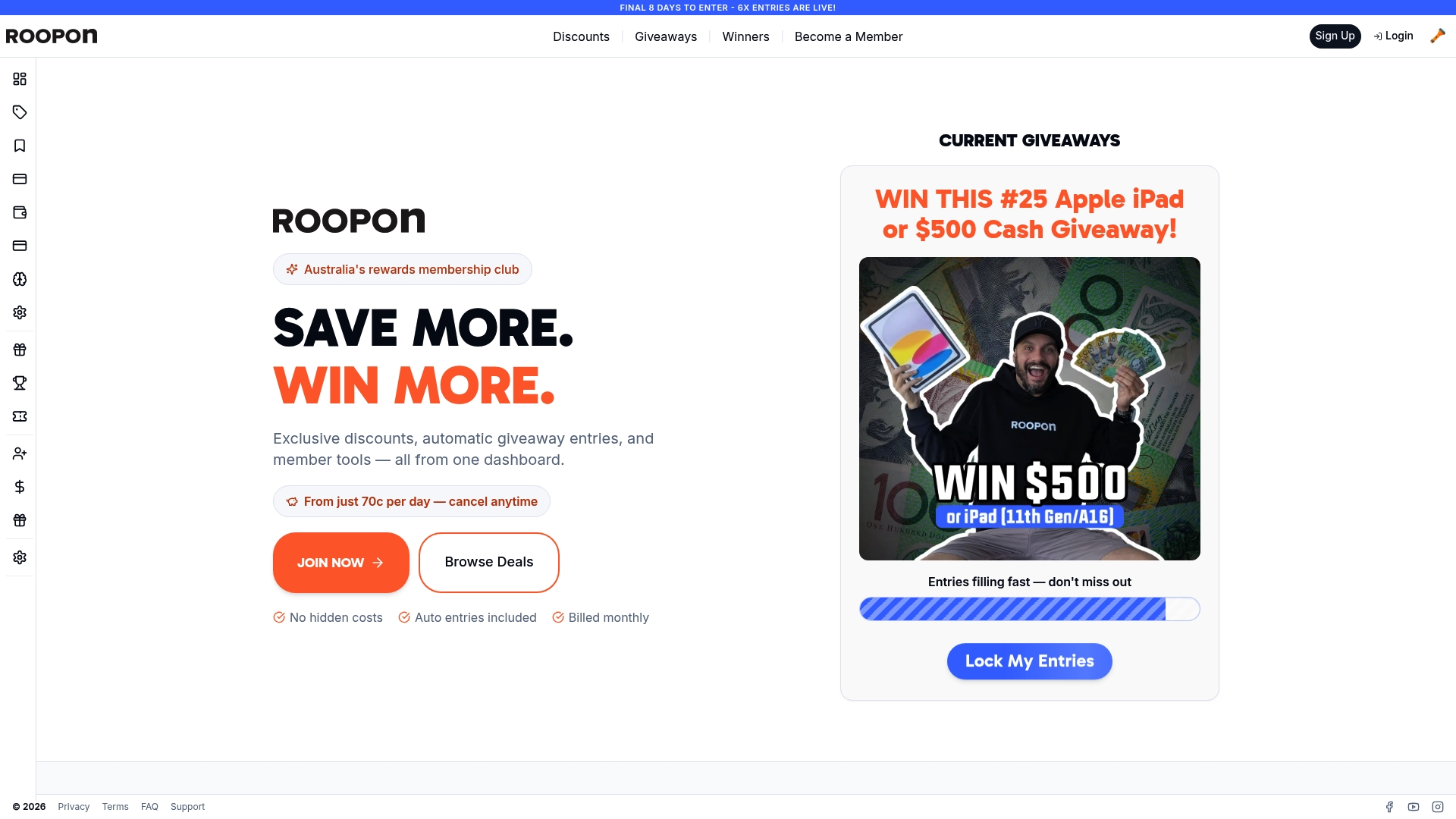
Roopon members receive FREE included prize-draw entries per their plan for weekly prize draws. Shopping does not automatically earn extra FREE entries. Extra packages exist for specific campaigns. The draws are transparent, the rules are published, and winners are notified through official channels. Campaign terms and the winners record are what you can check. This page does not state odds, and it does not say a programme passes a legitimacy test.
FAQ
What makes a prize programme legitimate?
A legitimate prize programme publishes complete official rules, requires no payment to enter or claim, and notifies winners through the channels specified in those rules. The sponsor must be a verifiable business with consistent contact details.
How do I spot warning signs of scam prizes?
The clearest warning signs are requests for upfront payment, unsolicited notifications, urgency pressure, secrecy demands, and missing or vague official rules. Any one of these signals a likely scam.
Are FREE entry methods required in Australian prize draws?
Australian prize promotions that involve a purchase requirement must offer an Alternate Method of Entry (AMOE) to avoid being classified as an illegal lottery. A legitimate programme makes this free entry option easy to find.
What should I do if I receive a suspicious prize notification?
Do not respond, do not pay anything, and do not provide personal or financial details. Report the notification to Scamwatch via the ACCC website. Cross-check any prize claim against the giveaway scams guide before taking further action.
How can I verify a prize programme sponsor in Australia?
Search the sponsor's Australian Business Number (ABN) on the Australian Business Register at abr.business.gov.au. Confirm the physical address, trading name, and registration status match the details in the official rules document.
