

TL;DR:
- Trustworthy prize programs feature FREE entry, transparent rules, and independent winner selection to ensure fairness. Examples like the National Park Foundation, Microsoft, and BBC demonstrate operational clarity and legal compliance that scammers cannot imitate. Recognizing these traits helps participants distinguish legitimate draws from fraudulent schemes across various industries and jurisdictions.
Legitimate prize programs are competitions or sweepstakes that guarantee fair entry without requiring a purchase, backed by transparent official rules and trusted organisers. The most reliable examples of legitimate prize programs share three non-negotiable features: a free entry method, independent winner selection, and clear prize notification processes. Programmes from organisations like the National Park Foundation, Microsoft, and BBC's Comic Relief demonstrate exactly what trustworthy prize draws look like in practice. Understanding these features helps you tell real prize giveaways apart from scams before you hand over a single detail.
What are common traits of trustworthy prize programs?
Trustworthy prize programs follow a consistent set of operational standards that separate them from fraudulent schemes. Recognising these traits is the fastest way to assess whether a competition is worth your time.
- No purchase necessary. Every legitimate contest example offers a genuinely free way to enter. This is known as an Alternate Method of Entry (AMOE), and AMOE must be equally accessible and free, with no hidden barriers or burdensome steps. Buying a product cannot improve your odds.
- Clear, accessible official rules. Rules must state the prize value, entry period, eligibility criteria, odds of winning, and how winners are notified. If you cannot find the official rules within two clicks, treat the programme with caution.
- Independent winner selection. Authentic prize draws use random computer processes or independently verified systems to select winners. This removes any possibility of bias or manipulation.
- Prompt winner notification. Legitimate programmes specify exact notification timelines. The Formula 1 Silverstone prize draw notifies winners by email with a 7-day response window before the prize is forfeited. That level of operational detail is a strong legitimacy signal.
- No upfront fees or sensitive data requests. A real programme never asks for payment to claim a prize or requests your bank details before you have formally won.
Pro Tip: Search the promoter's name alongside "official rules" or "terms and conditions" before entering any draw. If no document appears, skip it.
The UK's Formula 1 and US-based NIH Federal Credit Union sweepstakes both publish these details openly. That transparency is not accidental. It is the standard that regulators expect and that participants deserve.
1. National Park Foundation Adventure Awaits Sweepstakes
The National Park Foundation's Adventure Awaits Sweepstakes is one of the clearest examples of a legitimate, well-run prize programme from a trusted non-profit. The 2026 sweepstakes runs from 1 June to 31 July, is open to legal US residents aged 18 and over, and requires no purchase to enter. The grand prize includes flights and cash, and winners are notified in September 2026.

What makes this programme stand out is the combination of a reputable organiser, a clearly defined entry window, and a prize with stated monetary value. There is no ambiguity about what you win or when you hear back. For anyone learning how to find prize programs worth entering, this is the benchmark.
2. Microsoft Zero Day Quest 2026
Microsoft's Zero Day Quest is a legitimate prize programme aimed at security researchers rather than general consumers, and it shows that authentic prize draws exist across many industries. Microsoft awarded $2.3 million through this programme in 2026, receiving nearly 700 research cases and identifying over 80 high-impact vulnerabilities.
The programme includes qualifying challenges and a live hacking event, with prizes tied to the quality and impact of submitted research. This is a skill-based contest rather than a chance draw, which means the legitimacy markers shift slightly. Judging criteria are published, prize tiers are disclosed, and winners are selected through a transparent evaluation process. It demonstrates that verified sweepstakes examples are not limited to consumer giveaways.
3. BBC Comic Relief Harry Free Prize Draw
The BBC's Comic Relief Harry Free Prize Draw is a charity-run programme that offers hospitality tickets as prizes, with both online and free postal entry routes available. Online FREE entries closed 19 April, postal FREE entries closed 24 April, the winner was selected on 5 May, and notification occurred on 6 May 2026. That level of date-specific operational detail is exactly what separates a real prize draw from a vague promotional scheme.
The free postal entry option is the AMOE in this case, meaning no donation is required to participate. The BBC's involvement as a publicly accountable broadcaster adds an additional layer of credibility. This is a strong example of safe online prize promotions run by a well-known institution.
4. Formula 1 Silverstone Unlocked David Guetta Prize Draw
Formula 1's Silverstone Unlocked prize draw covers event tickets and accommodation, with no purchase required to enter. The draw uses a random selection process, and odds are stated to depend on the total number of FREE entries received. Winners are notified by email and must respond within seven days or forfeit the prize.
This programme is a textbook example of operational legitimacy. The terms and conditions specify the prize description, entry method, notification process, and forfeiture rules in plain language. For readers researching examples of prize competitions from global brands, the Formula 1 draw is worth studying as a model of how transparent terms should read.
5. NIH Federal Credit Union Nurses and Money Survey Sweepstakes
The NIH Federal Credit Union Nurses and Money Survey Sweepstakes targets healthcare professionals and offers $500 gift cards as prizes. No purchase is necessary, with both online and mail entry options available. Mail entries must be postmarked between 29 April and 31 May 2026, and entrants must be healthcare professionals aged 18 or over in the US.
This programme illustrates how legitimate contest examples can be tailored to specific professional groups while still meeting all standard legitimacy requirements. The dual entry method, stated eligibility criteria, and defined prize value all signal a well-structured, authentic prize draw. Healthcare workers in Australia can use this as a reference point when evaluating local programmes targeting their profession.
6. One Stop Easter Catch and Collect Competition (UK)
UK retailer One Stop's Easter competition demonstrates how retail-linked prize draws can still meet legitimacy standards. Independently verified prize draw systems and publicly disclosed winner notification deadlines are central to this programme's credibility. Prize claim deadlines are stated clearly, and forfeiture rules apply if winners do not respond within the required timeframe.
Retail prize draws are common, but many fall short on transparency. One Stop's approach of using independent verification and publishing odds and deadlines sets a standard that other retail promotions should follow. This is a useful reference when assessing whether a supermarket or retail giveaway qualifies as a real prize giveaway.
How do legitimate prize programs comply with legal requirements?
Legal compliance is what separates a trustworthy prize programme from a promotional scam. The rules differ by country and, in Australia, by state and territory.
In Australia, trade promotions require permits specific to each jurisdiction, with thresholds based on prize value. Australian Consumer Law also prohibits misleading advertising about prizes or entry conditions. A programme that overstates prize values or obscures entry requirements breaches these rules. Understanding Australian giveaway laws as a participant helps you recognise when a promotion is operating outside its legal obligations.
| Requirement | What it means for participants |
|---|---|
| State-based permits | Promoters must hold permits in NSW, ACT, and SA for prize draws above certain thresholds |
| No purchase necessary | FREE entry must be genuinely available and equally accessible |
| Accurate advertising | Prize descriptions and odds must not mislead entrants |
| Winner notification | Timeframes and contact methods must be stated in official rules |
| Prize claim deadlines | Unclaimed prizes have defined forfeiture rules |
Pro Tip: Before entering an Australian prize draw, check whether the promoter lists a permit number in the terms and conditions. Its absence in a high-value draw is a warning sign.
Australian prize compliance is complex because each state applies different rules. A promoter running a national competition must satisfy the requirements of every jurisdiction where entrants reside. That complexity is why legitimate programmes invest in proper legal advice before launching.
Sweepstakes, contests, and giveaways: what is the difference?
These three terms are often used interchangeably, but they describe distinct programme types with different legitimacy criteria.
| Programme type | How winners are chosen | Purchase required? | Key legitimacy marker |
|---|---|---|---|
| Sweepstakes | Random chance draw | No. AMOE required by law | Free entry method clearly stated |
| Contest | Skill-based judging | Sometimes | Published judging criteria and qualified judges |
| Giveaway | Random or first-come | Varies | Clear eligibility and prize description |
Sweepstakes are the most tightly regulated because purchase cannot improve odds in a chance-based draw. That rule exists to prevent promoters from running what would otherwise be an illegal lottery. Contests, by contrast, can require entry fees in some jurisdictions because skill determines the outcome. Giveaways sit somewhere in between, often used as marketing tools with simpler rules but still subject to consumer protection laws.
The overlap across all three types is rules clarity and fairness. Whether you are entering a sweepstakes, a contest, or a giveaway, the promoter must tell you what you can win, how winners are chosen, and when you will hear back. Any programme that withholds this information is not operating legitimately, regardless of what it calls itself.
Key takeaways
Legitimate prize programs are defined by FREE entry, transparent rules, and independent winner selection. These three elements are non-negotiable across every programme type and jurisdiction.
| Point | Details |
|---|---|
| FREE entry is mandatory | Every legitimate draw must offer an AMOE that is equally accessible and does not affect winning odds. |
| Rules must be specific | Official rules should state prize value, entry dates, eligibility, and winner notification timelines. |
| Legal compliance varies by location | Australian promoters must hold state-based permits; international programmes follow their own jurisdictional rules. |
| Programme type affects legitimacy criteria | Sweepstakes require no purchase; contests may allow entry fees if skill-based judging applies. |
| Operational detail signals trust | Exact notification dates, forfeiture rules, and independent verification are markers of a genuine programme. |
Our take on participating safely in prize programs
- Roopon Team
The programmes listed in this article share one quality that scam operations cannot fake: operational specificity. When a promoter publishes exact entry closing times, names the date winners will be contacted, and explains what happens if a winner does not respond, that level of detail costs them nothing except accountability. Scammers avoid accountability. Legitimate promoters welcome it.
The most common mistake people make is entering programmes run by promoters they cannot independently verify. A well-known brand, a registered charity, or a publicly accountable institution like the BBC or National Park Foundation carries reputational risk if it runs a dishonest draw. That risk is your protection as a participant.
Be realistic about odds. More entries mean worse odds. It is that simple. A programme with 500,000 entrants and a single prize is a needle in a haystack. Programmes with smaller, targeted audiences, like the NIH Federal Credit Union sweepstakes for healthcare professionals, offer meaningfully better odds because the eligible pool is smaller. Align your entries with programmes where your eligibility narrows the field.
⚠️ Never enter a programme that asks for payment before releasing a prize, requests your bank account details upfront, or cannot produce official rules on request. These are not edge cases. They are the standard operating procedure of prize scams.
- Roopon Team
Roopon: real savings and reliable prize draws for Australians
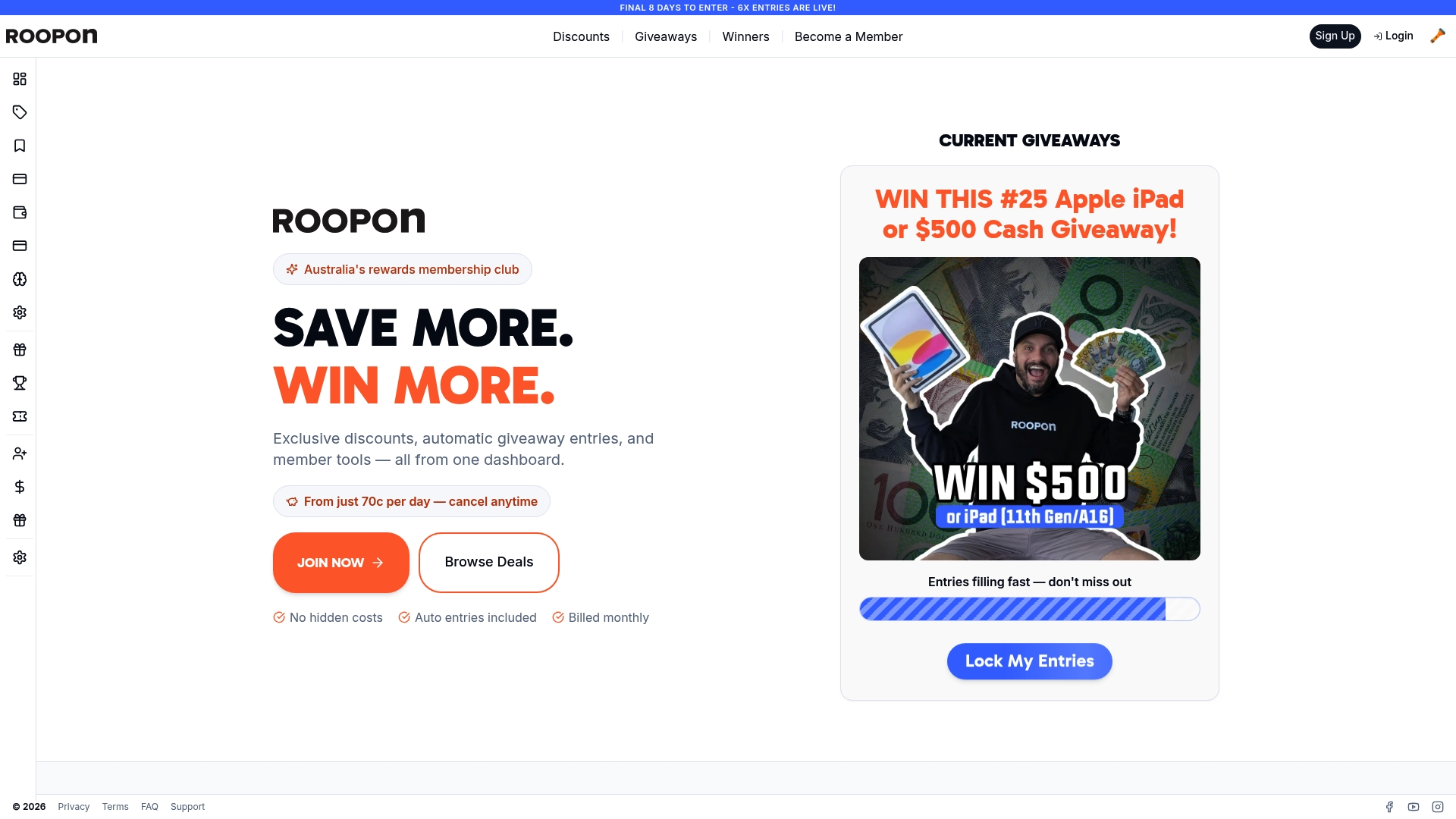
Roopon offers Australians a straightforward way to access both exclusive discounts and transparent prize draws without the guesswork. Members receive FREE included prize-draw entries per their plan and published campaign terms. See weekly cash prize draws and /giveaways for current prizes — they change. Extra FREE entry packages exist for specific campaigns. Roopon also offers targeted savings for specific groups, including healthcare workers and students, combining partner discounts with FREE prize-draw entries. If you want a cash prize draw that meets the same legitimacy standards described in this article, Roopon is built around exactly that.
FAQ
What makes a prize program legitimate?
A legitimate prize programme offers a FREE entry method, publishes clear official rules, and selects winners through an independent random or skill-based process. No purchase should be required to enter or improve your odds.
Do Australian prize draws need a permit?
Yes. Australian trade promotions require state-based permits in jurisdictions like New South Wales, the ACT, and South Australia when prize values exceed set thresholds. Promoters must also comply with Australian Consumer Law on accurate advertising.
What is an AMOE and why does it matter?
An Alternate Method of Entry (AMOE) is a free way to enter a prize draw without making a purchase. It is legally required in chance-based sweepstakes to prevent the draw from being classified as an illegal lottery.
How can I verify if an online prize draw is genuine?
Check for published official rules, a named promoter with a verifiable public profile, stated prize values, and a clear winner notification process. Use Roopon's online giveaway checklist to assess any Australian draw before entering.
What is the difference between a sweepstakes and a contest?
A sweepstakes selects winners by random chance and cannot require purchase. A contest selects winners based on skill or merit and may allow entry fees in some jurisdictions, provided judging criteria are published and applied fairly.
