

TL;DR:
- Layered discounts such as coupons, cashback, and loyalty rewards compound savings on regular shopping, especially when combined strategically. Australian shoppers benefit most from stacking multiple independent offers, like cashback portals, promo codes, and rewards cards, to maximize savings. The key to effective discount use is understanding how different types work and avoiding common pitfalls such as miscalculating combined discounts or falling for inflated prices.
Everyday purchase discounts are defined as layered savings opportunities that reduce your out-of-pocket spending across regular shopping categories. Understanding how they work means recognising that price cuts, coupons, cashback rebates, and loyalty rewards each operate differently but compound when combined. A disciplined Australian shopper spending $800 monthly can save $50–$120 by combining cashback apps, browser extensions, and digital coupons without changing shopping habits. That figure shows just how much is left on the table when shoppers rely on a single discount method. Roopon's approach to everyday savings is built on exactly this principle: stack the right offers, and the results speak for themselves.
How everyday purchase discounts work: types and key differences
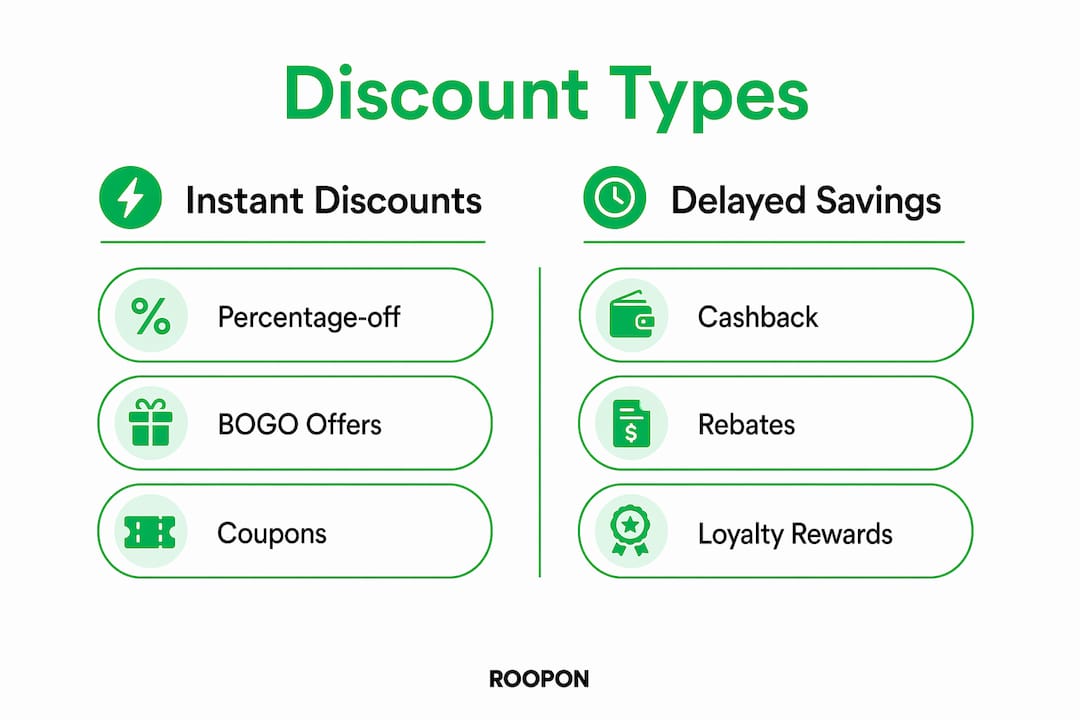
Discounts fall into two broad categories. The first is a point-of-sale reduction, where the price drops before you pay. The second is a post-purchase return, where you pay full price and receive money back later. Knowing which type you are dealing with changes how you plan your spending.

Percentage-off discounts are the most common. A retailer marks an item at $80 and offers 25% off, so you pay $60 at the register. Simple and immediate.
Coupons and promo codes work the same way but require an extra step. You apply a code at checkout or present a physical voucher in-store. The reduction happens instantly. Digital coupon platforms and retailer apps are the main sources for these in Australia.
Rebates and cashback are different in a critical way. Cashback is a rebate, not an instant discount. You pay full price upfront and wait 30–90 days for funds to post to your account. Conditions apply, and missing a step can mean losing the reward entirely.
Loyalty rewards work on future value. You earn points or credits on purchases today and redeem them later. The savings are real but deferred, which means they require consistent participation to deliver meaningful returns.
| Discount type | Timing | Typical conditions | Value certainty |
|---|---|---|---|
| Percentage-off | Instant | None beyond eligibility | High |
| Promo code / coupon | Instant | Code must be valid and applied | High |
| Cashback / rebate | 30–90 days post-purchase | Account, portal, and purchase rules | Medium |
| Loyalty rewards | Future redemption | Points threshold and expiry | Medium |
| BOGO offers | Instant | Must purchase qualifying item | Variable |
⚠️ BOGO offers deserve special attention. A "buy one, get one 50% off" deal effectively delivers only a 25% unit discount, not 50%. That matters when you are comparing offers across stores.
Pro Tip: Before choosing between cashback and an instant discount, check whether the cashback portal requires a minimum spend or a specific payment method. Missing one condition can wipe out the entire rebate.
How does discount stacking work?
Discount stacking is the practice of combining multiple independent savings methods on a single purchase. Each discount applies sequentially on a new price base, which means stacking discounts produces diminishing returns but still delivers meaningful savings. Think of it as peeling layers off the price one at a time.
The most effective online stack follows three steps:
- Shop through a cashback portal. Activate the cashback offer before you visit the retailer's website. This earns a percentage back on your total spend.
- Apply a promo code at checkout. This reduces the price before the cashback calculation in most portals, so your cashback applies to the discounted price.
- Pay with a rewards-linked card. Your credit or debit card earns points or cashback on the final transaction amount.
The triple-stack strategy is the standard method experienced savers use for online purchases. Each layer comes from an independent source, so they do not conflict.
In-store stacking follows a similar logic. A manufacturer's coupon reduces the shelf price. A store-specific loyalty discount applies on top. If you pay with a rewards card, you earn points on the remaining balance. Three independent layers, one purchase.
| Stack layer | Source | Applies to |
|---|---|---|
| Promo code / coupon | Retailer or coupon site | Original price |
| Cashback portal | Third-party app or browser extension | Post-code price |
| Rewards card | Bank or card issuer | Final checkout amount |
| Loyalty programme | Retailer membership | Eligible categories |
Store policies vary significantly on which coupons can stack. Some retailers prohibit stacking two store coupons but allow a manufacturer coupon alongside a store offer. Policies also change without notice.
Pro Tip: Keep a simple note in your phone listing the stacking rules for your three or four most-visited stores. Update it when you notice a policy change. This takes five minutes and saves real money over time.
What are the most common discount pitfalls to avoid?
Discount arithmetic trips up even experienced shoppers. The most common mistake is assuming that two percentage discounts add together. They do not. Stacking 30% off with an additional 20% off results in a 44% total discount, not 50%. A $100 item costs $56 after both discounts apply sequentially, not $50.
Here are the pitfalls worth watching for:
- The anchor price trap. Retailers sometimes inflate the "original" price before applying a discount to make the saving look larger. Check price history using a price tracker before assuming a discount is genuine.
- BOGO on items you do not need. Buying two to save on one only saves money if you would have bought both anyway. Otherwise, you spend more than planned.
- Cashback conditions. Cashback can be lost if conditions are not met, including using the wrong browser, clicking through the wrong link, or returning part of an order.
- Expiry dates on coupons and codes. A promo code that expired yesterday is worth nothing. Always check the validity period before building a purchase plan around it.
- Misleading discount claims. Regulatory bodies including the Australian Competition and Consumer Commission (ACCC) have guidelines on misleading pricing. If a discount claim looks too good, verify the base price independently.
Pro Tip: Before applying any coupon or code, search the item's price history. A genuine 40% discount is worth chasing. A 40% discount off an inflated price is not.
Discount strategies that suit Australian shoppers
Australian consumers have access to a specific set of tools and programmes that make discount stacking practical for everyday spending. Grocery and online retail are the two categories where consistent savings are most achievable.
The best cashback apps in Australia integrate directly with major retailers and activate through browser extensions or dedicated apps. They work in the background, which means you do not need to change your shopping behaviour to benefit.
Practical strategies for Australian shoppers include:
- Combine loyalty programmes with cashback. Major Australian supermarkets and fuel retailers run points programmes. Activating a cashback portal on top of your existing loyalty membership adds a second savings layer at no extra effort.
- Use browser extensions for online purchases. Extensions that automatically apply promo codes and activate cashback portals at checkout are widely available and free. They remove the manual step of searching for codes.
- Check for salary packaging or workplace discount programmes. Some Australian employers offer salary packaging arrangements or access to workplace discount platforms. These can apply to everyday categories including groceries, electronics, and fuel.
- Time purchases around retailer sale cycles. Australian retailers follow predictable sale calendars, including end-of-financial-year sales in june and post-Christmas clearances. Stacking a promo code on top of a sale price compounds the saving.
- Use digital coupon sources specific to Australia. Australian-focused deal communities and coupon aggregators list current codes for local retailers. Generic international coupon sites often list codes that do not work on Australian store checkouts.
For a detailed breakdown of how membership clubs compare to cashback apps in terms of real savings, the difference is more significant than most shoppers expect. Membership models that offer fixed percentage discounts across partner stores can outperform variable cashback rates when your spending aligns with the partner network.
Retailers also use behavioural triggers to deliver discounts. Abandoned cart discount codes are sent automatically within 24–48 hours when a shopper leaves items in an online cart without purchasing. Leaving a cart overnight before completing a purchase is a legitimate and widely used tactic.
Key takeaways
Everyday purchase discounts deliver the most value when you layer multiple independent savings methods on the same purchase rather than relying on a single offer.
| Point | Details |
|---|---|
| Discount types differ by timing | Instant discounts reduce price at checkout; cashback and rebates return funds 30–90 days later. |
| Stacking compounds savings | Combining a promo code, cashback portal, and rewards card creates three independent savings layers on one purchase. |
| Discount arithmetic is not additive | Two sequential percentage discounts do not add together; 30% plus 20% equals 44%, not 50%. |
| Verify prices before claiming savings | Check price history to confirm the base price is genuine before treating a discount as valuable. |
| Australian-specific tools exist | Local cashback apps, loyalty programmes, and workplace discount schemes suit Australian spending patterns directly. |
The honest reality of discount hunting
— Roopon Team
After working with Australian shoppers across a wide range of spending profiles, the pattern is consistent. The shoppers who save the most are not the ones who spend the most time hunting deals. They are the ones who set up two or three reliable systems and use them every time without thinking about it.
The biggest missed opportunity is not the mega-sale or the rare 60% off event. It is the consistent 5–15% saving that compounds across every grocery run, every online order, and every fuel fill-up across a full year. That is where the real money sits.
The cautionary note is equally consistent. Overcomplicating your approach erodes the benefit. Chasing every deal, maintaining ten different apps, and spending an hour researching a $30 purchase is not a savings strategy. It is a hobby with a modest financial return. The sweet spot is a small number of well-chosen tools applied consistently.
Roopon's model reflects this directly. Access to exclusive mates rates across over 16 partner stores, combined with a Payday Allocator for budgeting, means the system does the work. You shop as normal and the savings follow. That is the version of discount strategy worth building.
Roopon makes everyday savings practical for Australians
Roopon is built for Australians who want real savings on everyday spending without the complexity of managing multiple apps and programmes.

Roopon members access exclusive mates rates across more than 16 partner stores, covering everyday categories from groceries to services. The platform is designed for specific groups who benefit most from consistent discounts, including students, teachers, seniors, nurses, and healthcare workers. FREE Prize-draw entries follow the plan and that campaign’s terms. This page does not state odds. Extra packages exist for specific campaigns. See /giveaways for current prizes. If you are ready to put a reliable discount system in place, Roopon is worth a look.
FAQ
What is the difference between a discount and cashback?
A discount reduces the price at the point of sale, so you pay less immediately. Cashback is a rebate paid after the purchase, typically within 30–90 days, and is subject to conditions being met.
Can you stack multiple discounts on one purchase?
Yes, in many cases. The most common approach is combining a promo code at checkout with a cashback portal and a rewards-linked payment card. Each layer applies independently, though retailer policies vary on what combinations are permitted.
Does stacking two percentage discounts double the saving?
No. Sequential percentage discounts apply to a new base price each time. Stacking 30% off followed by 20% off results in a 44% total saving, not 50%.
How do I know if a discount is genuine?
Check the item's price history using a price tracking tool before applying a code. The ACCC has guidelines on misleading pricing, and retailers are required to base discounts on genuine prior prices.
What is the easiest way for Australians to save on everyday purchases?
Combining a loyalty programme with a cashback app and a rewards credit card on regular spending categories is the lowest-effort approach. A disciplined shopper spending $800 monthly can save $50–$120 this way without changing shopping habits.
Recommended
- Student Discounts Australia 2026 — Real Savings for Uni Students | ROOPON | ROOPON
- Senior Discounts Australia 2026 — Stretch Your Pension Further | ROOPON | ROOPON
- Teacher Discounts Australia 2026 — Save More on What Matters | ROOPON | ROOPON
- Healthcare Worker Discounts Australia 2026 | ROOPON | ROOPON
