
Update (2026): Cashrewards closed in September 2025. If you want free cashback, use ShopBack. ROOPON is a paid membership with partner discounts and FREE included prize-draw entries — not a cashback clone.

TL;DR:
- Alternative cashback platforms reward users without receipt scanning across online portals, extensions, card-linked, and engagement apps. Combining these methods can significantly increase savings, especially when stacking multiple rewards from each category.
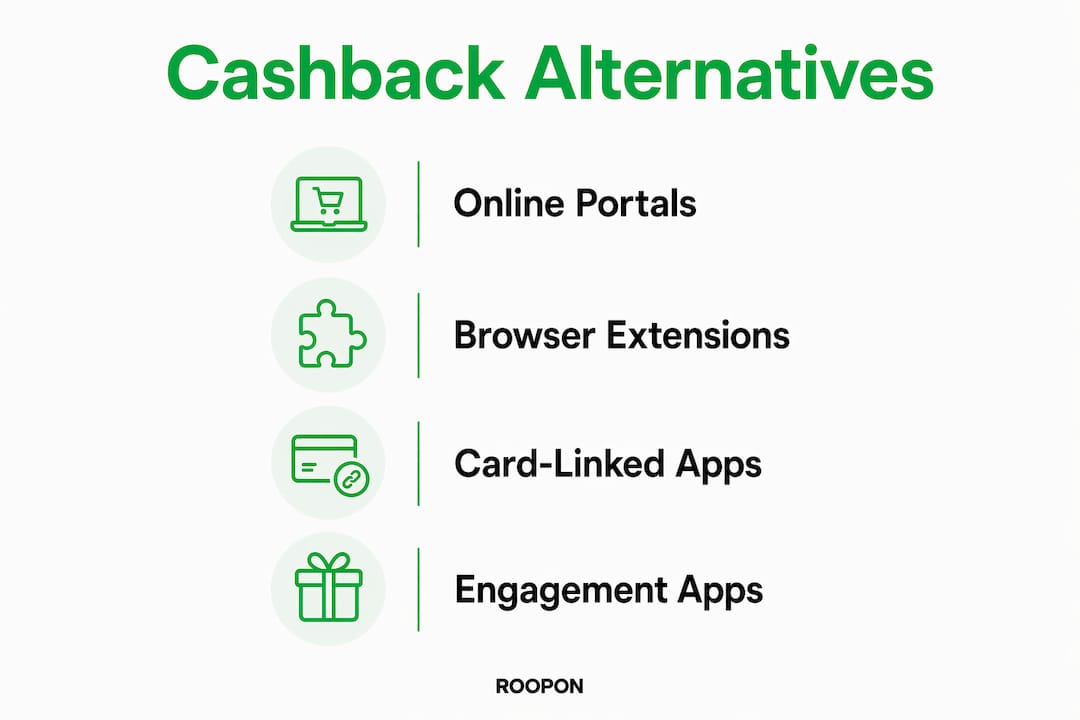
Alternatives to traditional cashback apps are platforms and tools that reward you without requiring receipt scanning, covering four main categories: online shopping portals, browser extensions, card-linked offer apps, and engagement apps. Rakuten, Capital One Shopping, and Dosh are the most widely recognised examples across these categories. Budget-conscious Australians who want to find alternatives to traditional cashback apps are increasingly moving toward these non-traditional models because they require less manual effort and often pay out faster. Stacking multiple types together is where the real savings happen.
What are the main types of cashback app alternatives?
Four main categories of cashback alternatives now exist, and each one works differently from the receipt-scanning model most Australians are familiar with. Understanding the differences helps you choose the right mix for your spending habits.
Online shopping portals activate cashback before you complete a purchase online. Rakuten is the best-known example. You click through the portal to a retailer's site, and the portal tracks your purchase automatically. No receipt required.
Browser extensions work at checkout without any extra steps. Capital One Shopping scans for coupons and cashback offers as you shop, applying the best available deal automatically. This is the most passive of the four types.
Card-linked offer apps connect directly to your debit or credit card. Dosh is the leading example. You link your card once, and rewards are triggered whenever you pay at a participating merchant. There is no activation needed per purchase.
Engagement apps are the most distinct category. Apps like VISU monetise user movement and QR code scans, providing earnings without any purchase requirement. You earn by visiting locations, scanning codes, or sharing anonymised data. These stack cleanly with the other three types because they operate on a completely separate earning mechanism.
| Category | Example | Tracking method | Receipt needed? |
|---|---|---|---|
| Online shopping portal | Rakuten | Affiliate link click | No |
| Browser extension | Capital One Shopping | Browser cookie | No |
| Card-linked offers | Dosh | Card transaction | No |
| Engagement app | VISU | Location/QR scan | No |
| Receipt scanning | Fetch, Ibotta | Manual photo upload | Yes |
The key difference between these non-traditional cashback apps and older receipt-based models is effort. Receipt apps require you to photograph every purchase. The four categories above run largely in the background.
How do you stack cashback alternatives for maximum savings?
Stacking means using multiple non-conflicting apps to earn rewards on the same purchase from different angles. Combining one passive card-linked app, one browser portal, and one engagement app is the most effective layered approach for everyday shoppers.
A practical stack for Australians looks like this:
- Activate Rakuten before any online purchase to earn portal cashback.
- Run Capital One Shopping in your browser to catch any additional coupons at checkout.
- Link your card to Dosh so in-store purchases earn card-linked rewards automatically.
- Use VISU during your regular daily routine to earn from location visits and QR scans without spending anything extra.
Users combining five different cashback and alternative apps can earn $60–$100 per month, compared to $15–$50 from a single app. That gap is significant for anyone watching their budget closely.
The critical rule with stacking is to check each app's terms of service. Some portals prohibit combining their cashback with browser extension discounts on the same transaction. Rakuten and Capital One Shopping, for example, can conflict on certain retailers. When in doubt, deactivate the extension and use the portal link directly.
Layering distinct reward types avoids conflicting terms and captures rewards across channels. The goal is to cover online spend, in-store card spend, and passive engagement simultaneously.
Pro Tip: Set a weekly five-minute check to activate any pending portal offers and confirm your card is still linked in Dosh. Missed activations are the most common reason stacking underperforms.
Cashback credit cards add another layer. Combining digital apps with cashback credit cards offering 3%–6% returns creates a compounding effect on top of app rewards. This is not double-dipping. Card rewards and app rewards operate through separate systems.
What should you consider when choosing non-traditional cashback apps?
The most important practical factor is payout speed and minimum threshold. Apps with lower minimum cash-out thresholds ($5–$10) and faster payouts (24–48 hours) maintain user motivation better than traditional apps with high thresholds and slow timelines. Waiting months to reach a $50 minimum discourages consistent use.
Payout method matters too. Direct bank deposit and PayPal are the most flexible options. Gift card payouts often come with restrictions and can represent a hidden value loss. Point system apps often have higher friction and value loss, so preference should go to apps that pay in direct cash.
Data privacy is a genuine consideration with engagement apps in particular. Reliable cashback alternatives have transparent data policies that allow members to maintain control over anonymised purchase data, rather than simply collecting it without clear disclosure. Before signing up, check whether the app sells your data to third parties and whether you can opt out.
Here are the warning signs of a low-quality cashback app:
- No clear privacy policy or data usage disclosure
- Payout minimums above $25 with no timeline guarantee
- Points-only rewards with no direct cash conversion
- Poor or absent customer support channels
- Frequent complaints about missing cashback in app store reviews
Pro Tip: Search "[app name] missing cashback" in Google before signing up. If the first page is full of unresolved complaints, that app is not worth your time.
Users increasingly favour cashback apps that pay out quickly with low thresholds, because delayed large amounts discourage continued use. Quick wins keep the habit going.
Which apps are worth trying for Australians in 2026?
The best cashback app alternatives for Australians right now cover each of the four main categories. For a broader view of what is available locally, the best savings apps in Australia roundup covers the full picture.
Online portals: Rakuten remains the strongest portal for online shopping, with a wide retailer network and reliable tracking. KashKick offers an alternative with a focus on low payout thresholds and quick payments.

Browser extensions: Capital One Shopping is the most capable extension for automatic coupon and cashback application at checkout.
Card-linked offers: Dosh is the leading card-linked option, requiring a one-time card connection and no further activation.
Engagement apps: VISU and Sweatcoin both offer earnings without purchase requirements, making them effective complements to spending-based apps. Sweatcoin converts steps into rewards. VISU uses location and QR activity.
Receipt-based complements: Fetch and Ibotta work well as grocery-specific additions to a broader stack, covering supermarket spend that portals and card-linked apps often miss.
| App | Type | Min. payout | Payout speed | Best for |
|---|---|---|---|---|
| Rakuten | Portal | $5 | Quarterly | Online shopping |
| KashKick | Portal/tasks | $10 | 1–3 days | Quick cash |
| Capital One Shopping | Extension | Varies | Varies | Automatic checkout |
| Dosh | Card-linked | $15 | 24–48 hours | In-store spend |
| VISU | Engagement | Low | Fast | Passive earnings |
| Sweatcoin | Engagement | N/A | Ongoing | Active lifestyle |
| Fetch | Receipt | $3 | 1–3 days | Groceries |
For a detailed cashback apps comparison covering the Australian market specifically, including which apps actually pay out reliably, that breakdown is worth reading before committing to a stack.
Key takeaways
The most effective approach to finding alternatives to traditional cashback apps is building a layered stack across all four categories: portal, extension, card-linked, and engagement.
| Point | Details |
|---|---|
| Four distinct categories exist | Portals, extensions, card-linked apps, and engagement apps each earn rewards differently. |
| Stacking multiplies earnings | Combining five apps can yield $60–$100 per month versus $15–$50 from one app alone. |
| Low thresholds keep you motivated | Choose apps with $5–$10 minimums and 24–48 hour payouts to stay consistent. |
| Direct cash beats points | Points systems carry friction and value loss; prioritise apps that pay in cash. |
| Privacy matters with engagement apps | Check data policies before linking location or card data to any platform. |
Roopon's take: what stacking taught us about real savings
The most common mistake new stackers make is treating all four categories as interchangeable. They are not. A portal and a browser extension can conflict on the same purchase. An engagement app and a card-linked app never will. Getting the combinations right is what separates $20 a month from $80 a month.
The second mistake is chasing high-earning apps with terrible payout experiences. We have seen members sign up for platforms promising big returns, only to spend weeks chasing missing cashback through unresponsive support. A reliable $10 payout in 48 hours beats a theoretical $40 payout that takes three months and a support ticket to arrive.
The third thing worth saying plainly: receipt-scanning apps are not dead, but they are the least efficient part of a modern stack. Use Fetch or Ibotta for groceries where portals cannot reach, but do not build your whole strategy around them. The limitations of traditional cashback apps for Australians are well documented, and the friction is real.
Start with one app from each category. Run them for 30 days. Then add a fourth. The habit builds faster than most people expect, and the monthly total starts to feel meaningful.
— Roopon Team
Roopon: savings beyond the cashback model
Cashback apps cover your spending, but Roopon covers your membership. Roopon gives budget-conscious Australians access to exclusive discounts across more than 16 partner stores, with no receipt scanning and no waiting for quarterly payouts.

Roopon members get 'mates rates' on everyday purchases, FREE included prize-draw entries per their plan and published campaign terms, and a Payday Allocator tool to keep their budget on track. FREE Prize-draw entries follow the plan and that campaign’s terms. This page does not state odds. Whether you are a student saving on uni costs, a tradie cutting everyday expenses, or a healthcare worker stretching a tight budget, Roopon adds a layer of savings that sits cleanly on top of any cashback stack you already run.
FAQ
What are the best cashback app alternatives for Australians?
The top options are Rakuten for online portals, Capital One Shopping for browser extensions, Dosh for card-linked rewards, and VISU or Sweatcoin for engagement-based earnings. Using one from each category gives the broadest coverage.
Can you use multiple cashback apps at the same time?
Yes, and combining distinct reward types is the recommended approach. The key is to avoid pairing apps that use the same tracking method on the same purchase, such as a portal and a browser extension on the same retailer.
How much can you realistically earn from stacking cashback alternatives?
Users combining five different apps earn $60–$100 per month on average, compared to $15–$50 from a single app. Results depend on spending volume and how consistently offers are activated.
Are engagement apps like VISU legitimate?
Yes. VISU and similar apps monetise location visits and QR scans rather than purchases. They are legitimate earning tools and stack well with spending-based apps because they operate on a separate mechanism entirely.
What payout type should I look for in a cashback app?
Direct cash via PayPal or bank deposit is the best option. Point system apps carry higher friction and value loss, and gift card payouts often come with spending restrictions that reduce their real value.
